

What is the best tape for sealing metal seams?


Author
More Industry Knowledge from Huizhou Senping Technology Co.,Limited
As Senping's in-house technical specialist, with close to twenty years of hands-on experience in industrial adhesive products. She knows well for adhesive butyl tapes, foam tapes, and pest-control glue traps,etc – from compound formulation to on-site application quirks. Over the past few years, she’s also dug deep into energy-saving infrared ceramic panels, working alongside installers to understand real-world performance, not just lab data. She’s the one who tests new batches on actual substrates, troubleshoots tricky bonds, and answers the questions that don’t show up on a data sheet. Should you have any questions, Sophia’s the person to ask. She doesn’t read from a script – she’s been on site, seen what fails, and knows what lasts. Drop her a line anytime; she actually enjoys the tricky ones.
Sophia


Let me tell you about the first time I watched a metal roof seam fail. I was standing in a warehouse, looking at a stain that ran the entire length of a steel panel. The silicone bead underneath—applied with care, smoothed out by a guy who knew what he was doing—had just let go. Peeled clean off the metal like an old sticker.
That was the day I stopped trusting anything that came out of a caulking tube for metal seams.
What Metal Does to Most Sealants
People don’t think about thermal movement until they see it bend a screw. A 30-foot metal panel can grow or shrink close to a quarter-inch across its width from summer noon to winter midnight. That’s not a guess—that’s measured movement. Now picture a hard-cured sealant sitting in that gap. It can’t stretch. It can’t compress. So it splits.
And the water finds it. Always does.
Silicone’s another trap. It beads water nicely at first. But it doesn’t bond to bare metal or painted coil without a primer. Even then, the adhesion’s superficial. Pull a cured silicone bead off galvanized steel and you’ll see nothing left on the surface—just clean metal where the sealant used to be.
Urethane caulks grab better but they shrink. Solvent evaporates, volume drops, and what looked like a full joint ends up with a concave channel that traps moisture. You can’t see the gap from ground level. But it’s there.
Enter Butyl Sealant Tape
I started using butyl sealant tape because a roofer with forty years of experience handed me a roll and said “use this instead.” Didn’t ask. Just handed it over.
The difference showed up immediately. Butyl sealant tape doesn’t cure. It doesn’t harden. It stays putty-soft and maintains adhesion over decades. That permanent tackiness is what makes it work on metal—because when the panel expands, the tape stretches. When it contracts, the tape rebounds. No cracks. No separation.
One installer I know calls butyl rubber tape “the forgiving sealant.” You can press it into uneven laps, around rivet heads, over standing seams with burrs. The material flows into those micro-gaps under pressure. That’s something no brush-on or tube-applied product does well.
Where I Reach for Butyl Waterproof Tape
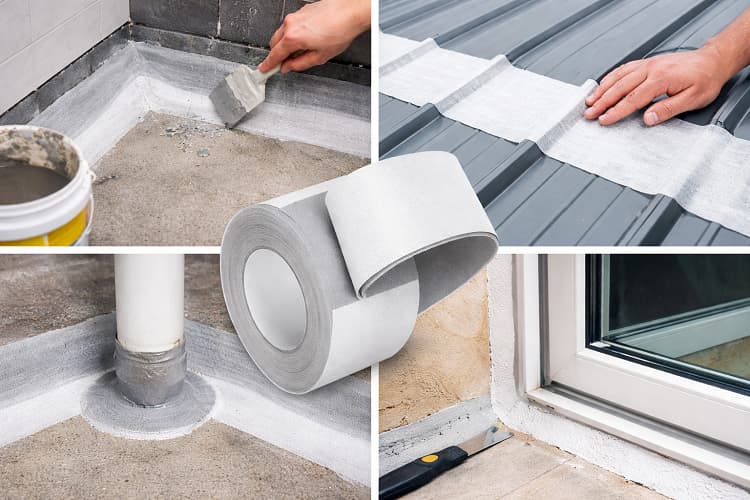
I keep a roll of butyl waterproof tape in the truck for three specific jobs:
Roof panel overlaps where the lap joint sits exposed to driving rain
Gutter end caps and downspout transitions
Flashing around pipe penetrations and vents
It’s also the only thing I’ll use on RV roof seams. Those aluminum skins move constantly on the highway—wind vibration, temperature swings, flexing. Silicone fails on RVs within a season. Butyl waterproof tape holds for years. You can drive a self-tapping screw right through butyl waterproof tape and the material seals around the threads instantly. No extra step, no second pass with sealant.
The Sun Problem
There’s one thing people miss with butyl rubber tape: sunlight eats it. The base compound isn’t UV-stable. If the seam sits exposed to direct sun all day, get butyl rubber tape with an aluminum foil laminate on top. The foil blocks UV and keeps the butyl rubber tape from degrading. Without that foil, you’ll see the tape surface start to dry and crack in about two years. Still functional underneath, but less pretty. With foil, you get the full 25-year life.
How to Apply It
Cut it with shears or a sharp utility knife. Don’t stretch it as you lay it down—stretching thins the material and reduces thickness where you need it most. Leave the release paper on until the mating piece is exactly positioned. Once the paper comes off and that butyl waterproof tape touches metal, it’s done. Not moving.
Press the seam together firmly. The tape compresses to about half its original thickness. That compression is what drives it into surface irregularities. No need for heat or special tools.
Cost and Convenience
A roll of quality butyl sealant tape runs a few dollars more than a tube of silicone. But that roll covers a lot more linear feet. And you don’t need a gun, cleaner, or special prep beyond degreasing the metal. Labor drops. Waste drops. Callbacks drop.
The Verdict
I’ve tried polyurethanes, acrylics, and all the hybrid polymer sealants that claim to do everything. I still go back to butyl rubber tape for metal seams every time. It’s boring, unglamorous, and doesn’t win any marketing awards. But I’ve never had to go back and repair a butyl-sealed seam that was installed right.
That’s the only test that matters.
- Use of Yellow Sticky Trap: What I Wish I'd Known Before Wasting Money on Sprays
- Glue Board Refill for Mosquito Lamps Universal Fit
- The Benefits of Using an Insect Trap Glue Board Over High-Voltage Zappers
- Why You Should Combine Yellow Sticky Tape Roll and Blue Sticky Tape Roll?
- Maintaining Food Safety Standards with replacement glue board for insect light
- The Home Gardener’s Guide to thrips yellow sticky traps