

Where to Place mouse trap sticky pads to Catch Smart Rats Fast?


Author
More Industry Knowledge from Huizhou Senping Technology Co.,Limited
As Senping's in-house technical specialist, with close to twenty years of hands-on experience in industrial adhesive products. She knows well for adhesive butyl tapes, foam tapes, and pest-control glue traps,etc – from compound formulation to on-site application quirks. Over the past few years, she’s also dug deep into energy-saving infrared ceramic panels, working alongside installers to understand real-world performance, not just lab data. She’s the one who tests new batches on actual substrates, troubleshoots tricky bonds, and answers the questions that don’t show up on a data sheet. Should you have any questions, Sophia’s the person to ask. She doesn’t read from a script – she’s been on site, seen what fails, and knows what lasts. Drop her a line anytime; she actually enjoys the tricky ones.
Sophia


Where to Place mouse trap sticky pads to Catch Smart Rats Fast?Most people approach glue boards like they're setting mousetraps in a cartoon—drop one in a corner, maybe add a bit of cheese, and wait. Then they wonder why the rats keep showing up and the boards stay clean.
The short answer: you're placing them wrong. And the rats aren't as dumb as you think.
The Blunder Principle
Here's what pest management professionals understand that most homeowners don't: mouse trap sticky pads are what the industry calls "blunder" traps. They're not designed to lure rats in. They're designed to intercept rats when those rats are moving fast and not paying attention.
When a rat scurries from its nest to a food source across an open floor, it moves in a more erect posture. Its whiskers and guard hairs stay held back against its body. The rat is focused on getting from point A to point B, not on scanning every inch of the floor.
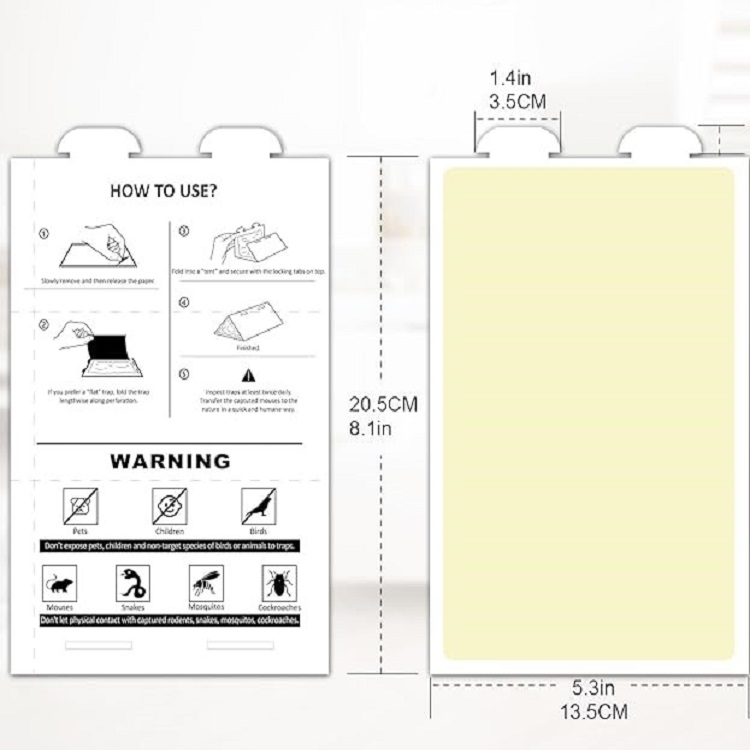
But when that same rat approaches a corner, a wall junction, or anything that looks like an obstacle? It slows down. Its posture drops closer to the ground. Those vibrissae—each one functioning like an individual finger—flare out and start feeling the environment. That's when it spots your trap and walks around it.
Never in Corners
This is why professionals never place glue boards in corners when targeting rats. It seems counterintuitive—rats hug walls, right? They do. But they slow down at corners, and a slow rat is a rat that avoids your trap. Put the board along a straight wall, in the middle of a runway, where the rat is moving at full speed. That's where the blunder happens.
Spacing and Strategy
For rats, space boards about ten to fifteen feet apart. For mice, five to eight feet. But don't treat this as a rigid formula. Every space is different. Look for signs—droppings, gnaw marks, greasy rub marks along surfaces. Those tell you where the runways are.
Place boards flush against baseboards along those routes. Behind refrigerators, along the sides of stoves, behind washing machines. In attics, crawlspaces, basements. Anywhere dark and warm with access to food or water.
Bait? Skip It
The instinct to put peanut butter in the center of a glue board is understandable. But it's also counterproductive. Bait makes a rat stop, slow down, and inspect. That's exactly when its whiskers come out and it detects the trap. An unbaited board in the right runway catches a moving rat. A baited board in the wrong spot catches nothing.
Pre-baiting: The Pro Move
Here's a technique that actually works. Place the boards out with the release paper still on. Let the rats walk over them for a few days. They get used to the boards. They leave scent trails. The board becomes part of their environment. Then peel the paper and set them for real. The rats don't think twice.
The Jump Factor
Rats can jump. Put one board down and a rat might clear it. So put three in a row, spaced about two inches apart. The rat jumps the first and lands on the second. Or place glue boards on either side of a snap trap. The rat sees the snap trap, tries to go around, and hits the glue. If it jumps, it lands on glue.
When to Move
Three days. If a mouse trap sticky pads sits empty for three days, that runway isn't active. Move it. Find the next route. And if you catch one rat, leave that board in place. Other rats get curious and sometimes walk right into the same board.
Final Word
Mouse trap sticky pads work. But they work when you understand how rats move, not when you guess where they might hide. Place them in runways, not corners. Let the rats get comfortable before you set them. And remember—you're not trying to lure a rat onto a trap. You're trying to catch one when it's not looking.
- Use of Yellow Sticky Trap: What I Wish I'd Known Before Wasting Money on Sprays
- Glue Board Refill for Mosquito Lamps Universal Fit
- The Benefits of Using an Insect Trap Glue Board Over High-Voltage Zappers
- Why You Should Combine Yellow Sticky Tape Roll and Blue Sticky Tape Roll?
- Maintaining Food Safety Standards with replacement glue board for insect light
- The Home Gardener’s Guide to thrips yellow sticky traps